How to cover all of Estonia
Based on the measurements, a 16-site network has been modelled using Levira’s existing high masts. The plan has two layers: a robust public warning layer (QPSK) and a higher-capacity media layer (16-QAM).
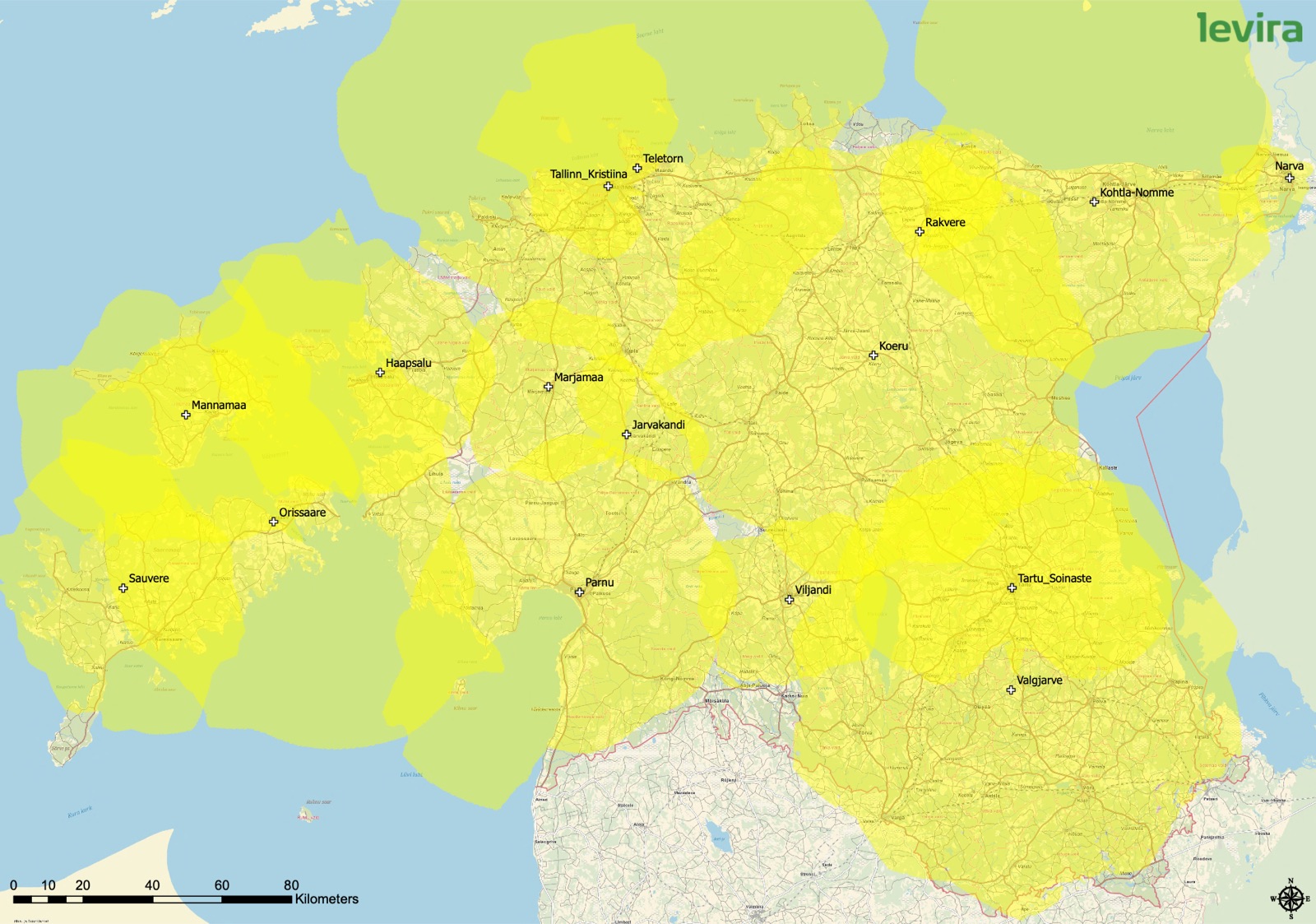
Public warning: QPSK
Alerts are small, and what matters most is that they get through. QPSK works with a weaker signal (SINR ≥ 3 dB, RSRQ ≥ −15 dB), so coverage is wide and reaches most of Estonia. Public warning should be planned on this layer.
Media: 16-QAM
TV and radio need a cleaner signal (SINR ≥ 10 dB, RSRQ ≥ −10 dB). This layer is narrower and concentrated around the main masts. The 16-QAM map shows service quality, not where public warnings reach.
Signal strength (RSRP)
16 transmitter sites
The country does not need one large single-frequency network. It works better to divide Estonia into regional clusters on three UHF channels: E40, E41 and E46.
| # | Site | Channel | Antenna height | ERP | Status |
|---|---|---|---|---|---|
| 1 | Tallinn TV Tower | E40 | 289 m | 18.8 kW | on air |
| 2 | Tallinn, Kristiina | E40 | 97 m | 1.5 kW | on air |
| 3 | Koeru | E41 | 335 m | 15 kW | on air |
| 4 | Pärnu | E41 → E46 | 187 m | 6.7 kW | on air |
| 5 | Järvakandi | E41 | 78 m | 1 kW | on air |
| 6 | Valgjärve | E41 | 336 m | 18 kW | planned |
| 7 | Tartu, Soinaste | E41 / E40 | 196 m | 3.5 kW | planned |
| 8 | Kohtla-Nõmme | E46 / E40 | 235 m | 15 kW | planned |
| 9 | Narva | E46 / E40 | 63 m | 1 kW | planned |
| 10 | Haapsalu | E40 | 117 m | 3.5 kW | planned |
| 11 | Viljandi | E41 / E40 | 75 m | 2 kW | planned |
| 12 | Orissaare | E46 | 188 m | 15 kW | planned |
| 13 | Sauvere | E46 | 120 m | 3.5 kW | planned |
| 14 | Männamaa | E46 | 116 m | 3.5 kW | planned |
| 15 | Märjamaa | E46 | 80 m | 2 kW | planned |
| 16 | Karitsa | E46 / E40 | 80 m | 2 kW | planned |
Northern Estonia
TV Tower and Kristiina, the northern coast layer.
Central and southern Estonia
Koeru and Valgjärve, the main inland layer.
Western and eastern Estonia
Pärnu, Orissaare and the islands, plus Kohtla-Nõmme and Ida-Viru County.
This is a working version of the plan. The final frequency plan requires an impact analysis of relocating digital TV multiplexes, coordination with neighbouring countries and SFN timing calculations. The baseline is a 200 µs cyclic prefix; 300 µs will also be checked for long distances and over sea.