What the tests have shown
The test days are organised together with the Ministry of the Interior, the Rescue Board, the Consumer Protection and Technical Regulatory Authority, RIKS, Levira and TalTech. Testers received the alert on a test phone and filled in a feedback survey right after.
Test days
Tallinn, Pärnu, Rakvere, At sea
All alerts reached the devices, even at the edge of coverage. One important technical finding: when a phone moves from one transmitter’s coverage to another (Pärnu → Koeru), the same alert is shown again with sound. Fixing this is one of the topics for the next period.
Tallinn: Pirita, Kristiine, city centre
All alerts reached the devices. Indoor conditions and reflections between tall buildings were tested. A duplicate alert also occurred between the TV Tower and Kristiina transmitters, confirming the finding from the first test day.
Pärnu: three realistic emergency scenarios
Real emergency wording was used for the first time. All three alerts reached the devices with priority HIGH. In all three cases the device was inside the calculated danger area: 251–471 m from the centre and 234–552 m from the edge.
Indoor reception in 13 shopping centres
The signal was measurable in most large shopping centres in and around Tallinn. It was most stable in Kristiine Centre, Lasnamäe Centrum and Nautica Centre. In Viru Centre and Solaris the signal was intermittent.
Pocket Siren closing seminar
Presentation of the pilot’s results, conclusions and recommendations to partners and other interested parties.
How the alert landed
Share of respondents who agreed or strongly agreed (n = 72)
What makes people act
readiness to act = risk perception + message clarity + noticeability
A stronger, clearer signal (sound and vibration) meant greater readiness to act immediately. The average clarity rating of the alert was 4.2 out of 5.
- Forest fire: the highest perceived threat and the strongest urge to act.
- Missing child: the strongest emotional reaction and good understanding of the text.
- Flood: a weaker immediate reaction. Testers wanted clearer instructions on what to do.
Testers also wanted more explanation of how the system works and what to do when an alert arrives. That is why this site includes both technical and practical information.
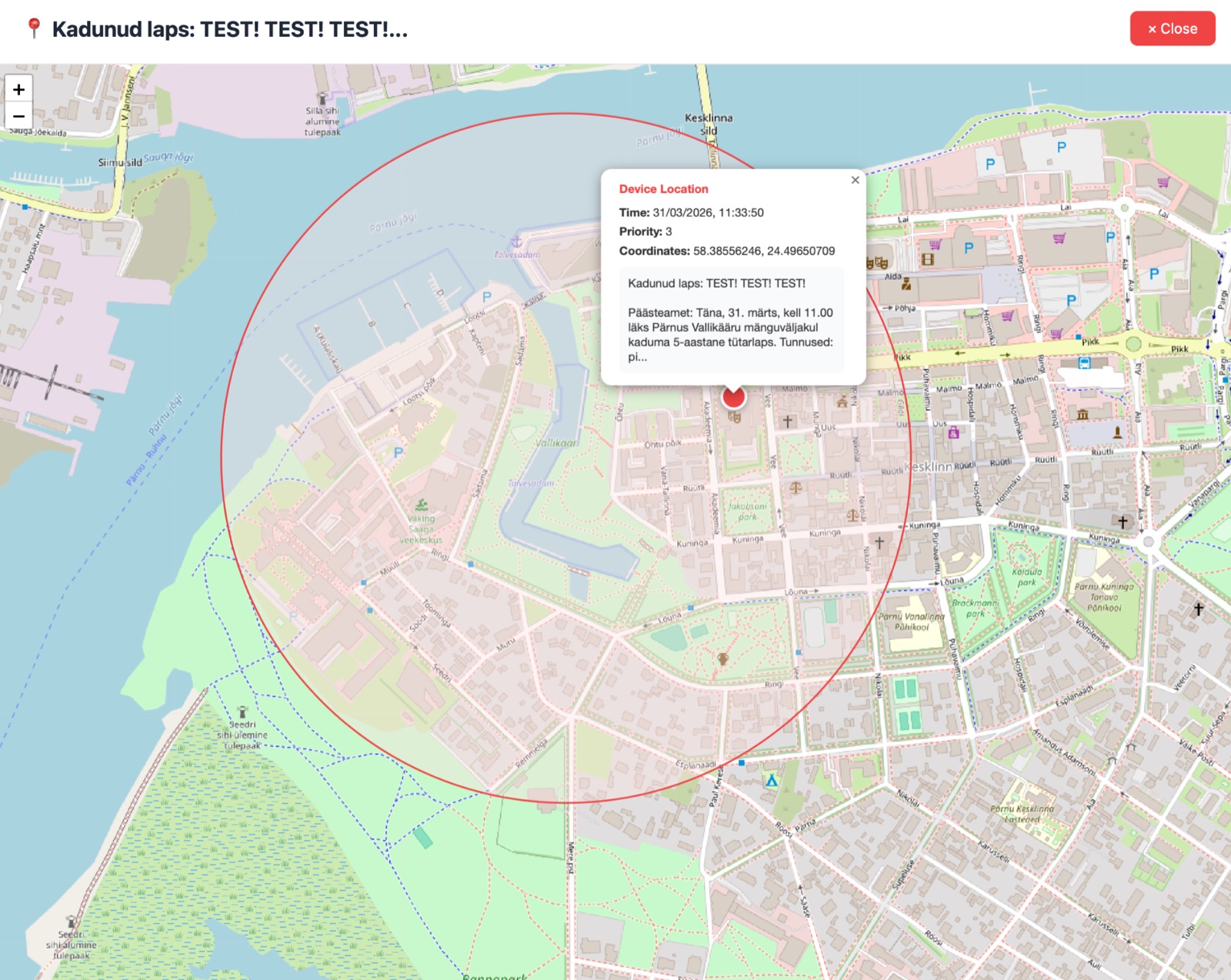
The right alert in the right place
| Scenario | Danger area radius | Distance from centre | Result |
|---|---|---|---|
| Missing child | 484 m | 251 m | Inside |
| Flood | 828 m | 471 m | Inside |
| Forest fire | 813 m | 260 m | Inside |
The phone waits up to 5 seconds to determine its location and shows the alert if the device is inside the danger area. Next, we need to test how phones behave with a weak GPS signal, indoors and at the edge of the danger area.