10 December Testing

On Wednesday, 10 December, the Pocket Siren emergency alert technology will be tested in Tallinn. Although special testing devices will be used, some mobile phone users within the test area may still receive alert messages.

Pocket Siren is based on a 5G broadcast solution, and the current test network covers eight counties: Harju, Pärnu, Järva, Ida-Viru, Lääne-Viru, Rapla, Viljandi and Tartu. The technology operates on digital television frequencies and enables both TV and radio broadcasting as well as fast emergency alerts. It is a unique solution that delivers alerts directly to smartphones, notifying users of major danger through sound, light and vibration. Since it is based on a broadcast network, alerts can also reach phones in situations where mobile networks are unavailable or the phone is in silent mode.

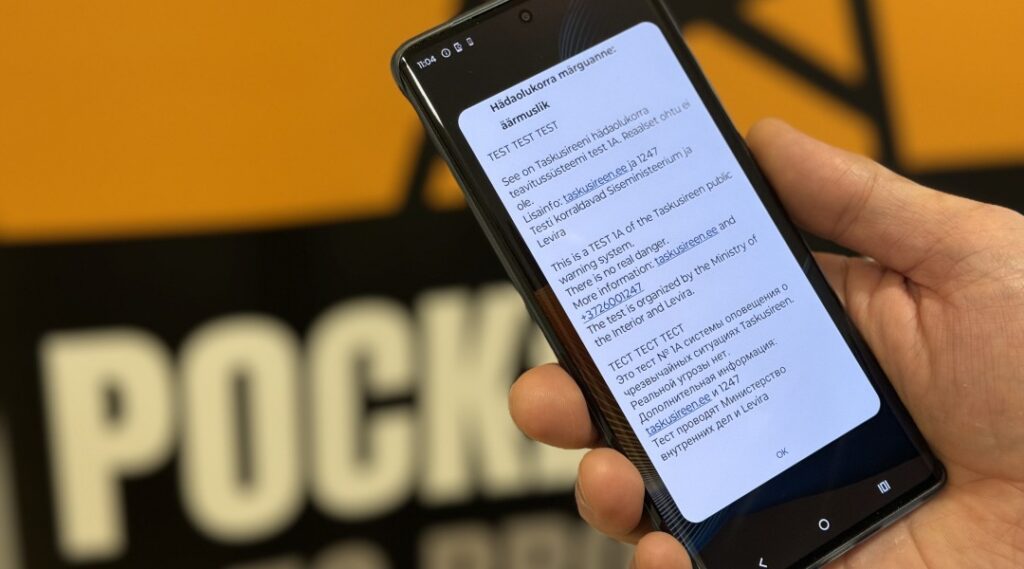
Together with its partners, Levira has identified at least 12 mobile device models that already support broadcast frequencies. This means that during the test, owners of these devices may receive test messages — if this happens, please keep in mind that there is no real threat. The Ministry of the Interior and its project partners kindly ask anyone who receives such a message to provide feedback via the website taskusireen.ee .

The test on 10 December will involve employees and volunteers from the participating organisations, as well as representatives of local authorities and other cooperation partners. The test aims to assess how the technology functions, what the user experience is like, and how well the alerts can be heard and seen.

The Pocket Siren project is led by the Ministry of the Interior, the Estonian Rescue Board, the Estonian Defence Forces, the Emergency Response Centre, the Consumer Protection and Technical Regulatory Authority, the Information Technology and Development Centre of the Ministry of the Interior, the State Communication Foundation and the Government Office of Estonia. Technological development and testing are carried out by Levira, TalTech, Tredess and Nakolos. The project is funded by the European Union Cohesion Policy funds for 2021–2027. More information and answers to frequently asked questions can be found at taskusireen.ee .
16.07.2025-Pocketsiren testing&technical information

Pilot Network for National Emergency Alert System “Taskusireen” Launched Using Innovative 5G Broadcasting Technology

A pilot network for the national emergency alert system, “Pocket Siren,” has been launched, based on a cutting-edge 5G broadcast solution. The network currently covers Harju, Pärnu, Järva, Ida-Viru, Lääne-Viru, Rapla, Viljandi, and Tartu counties. This new technology enables rapid and reliable alerts to the population in life-threatening situations, even when conventional communication channels are unavailable.

The Taskusireen pilot network (mux8) operates on digital TV frequencies E40 (626 MHz) and E41 (634 MHz), also known in the mobile sector as band n71. This enables the transmission of both television and radio content—currently including ETV and Vikerraadio channels—as well as emergency alerts directly to smartphones. Alerts are received instantly and include audio, visual, and vibration signals, even when the phone is in silent mode.

“To ensure the reliability and functionality of the network, various tests are being conducted to assess the entire emergency notification chain—from the decision to send an alert and the message composition to delivery to the end user. Attention is also given to signal activation according to threat levels, location-based delivery, and various device settings such as airplane mode,” explained Kristo Kaasan, CTO of Levira.

While most devices sold in the European Union do not yet support the technology used in the pilot network, successful development and testing could pave the way for broader adoption across Europe. This would, however, require future legislative changes and updates to frequency regulations.

Some smartphones on the market already support 5G broadcast technology. If you happen to receive an emergency alert during the pilot, please notify the project team at https://taskusireen.ee/.

In addition to regular technical tests, a large-scale system testing day is scheduled for July 16. During this test, Taskusireen’s full capabilities will be assessed in cooperation with partner organizations. This test is intended solely for the project team and will not affect the general public. “The main focus of the Taskusireen test day is the end-user experience. At TalTech, we are helping to evaluate how well people understand the alerts and how they respond to them. The user perspective is critical to ensure that the technology performs effectively in real crisis situations,” said Anet Tammets, project manager at TalTech.

The development of Taskusireen is based on initial system trials conducted at the Tallinn TV Tower in early 2024. The first public test, known as the “red button push,” took place at the tower in late April, demonstrating real-time alert transmission and the user experience on various devices.

The initiative is driven by the Ministry of the Interior, the Rescue Board, the Defence Forces, the Emergency Response Centre, the Consumer Protection and Technical Regulatory Authority, the IT and Development Centre of the Ministry of the Interior (SMIT), the State Infocommunication Foundation (RIKS), and the Government Office. Following a recent procurement, Levira and TalTech are developing and testing the technology. The project is being carried out on behalf of the Strategy Office of the Government Office and is funded from the European Union’s Cohesion Policy 2021-2027 period.